Corrected November 2026: the North by Northwest lines in this guide were checked against sources (the shooting script and a scene-by-scene synopsis), and the ones that were wrong in their specifics are rewritten. The Die Hard and Sicario lines were checked the same way afterwards, and Die Hard’s Sequences E to G now sit in their own stretches of the film. The timestamps and minute counts are gone, because no source gave them.
In the middle of North by Northwest, a bus drops an advertising man at a crossroads in empty farmland and drives off. Nothing happens for a long time. A car passes. A stranger waits for a different bus and mentions, almost to himself, that the plane over there is dusting crops where there are no crops. Then the plane turns toward the road. By the time the scene is over, you could show it to someone who has never seen the film and they would understand it completely.
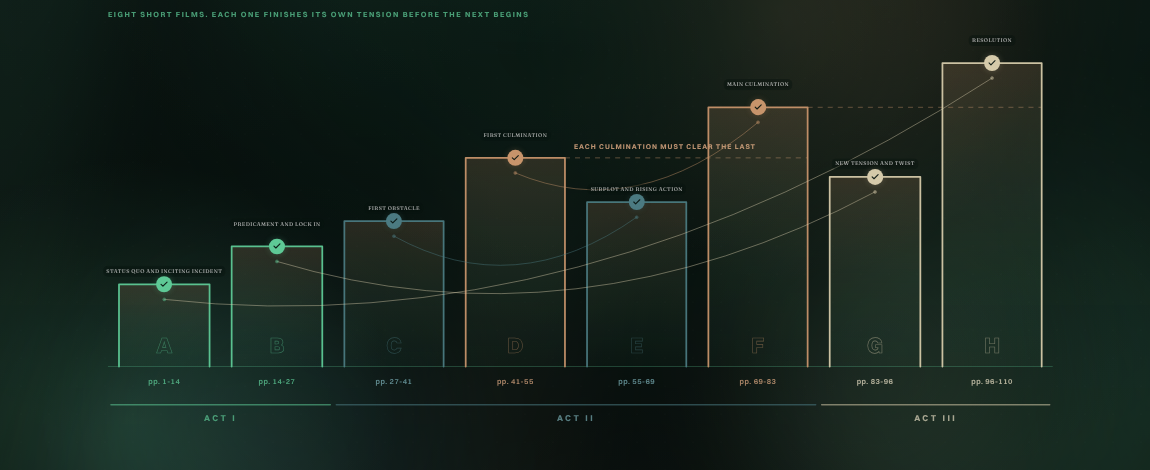
That is the idea behind the Sequence Method. A feature is not one long story with two act breaks in it. It is eight short films of twelve to fifteen pages each, and every one of them poses its own question, raises its own tension and answers it before it hands off to the next.
This guide walks the eight sequences through three films. Die Hard shows the seams of the form more clearly than anything else in the library. North by Northwest is the film the method’s best-known book teaches from. Sicario shows what the seventh sequence is really for. By the end you should be able to find the sag in your own second act and split it into rooms.
The Sequence Method in sixty seconds
The method belongs to Frank Daniel, the Czech-born teacher who ran the screenwriting programmes at Columbia, AFI and USC. Daniel noticed that films from the silent and early sound era were built in reels, each reel about ten to fifteen minutes long, and that the good ones treated each reel as a unit with a shape of its own. He taught the feature as eight of those units. He never wrote the book himself. His student Paul Joseph Gulino did, in Screenwriting: The Sequence Approach, which breaks down a run of classic and modern films sequence by sequence.
The shape is linear and it sits on top of three acts rather than replacing them. Sequences A and B are the first act. C through F are the long middle. G and H are the third act. The act breaks still exist, but the method gives you six more checkpoints in between them, and each one asks the same thing: what was the question at the start of this sequence, and how has the answer changed the situation?
It fits films with a strong external engine: thrillers, chases, procedurals, sieges, anything with a clock. It fits loose ensemble pieces and slow character studies less well, because their tension does not always arrive in fifteen-page doses, and forcing it to can make a quiet film feel like a series of mechanical reversals. The idea that separates it from its neighbours is the culmination. Daniel asked for two peaks in the middle, not one, and the second has to climb higher than the first.
The app teaches this structure as 8 beats, after Frank Daniel. You can walk them on a visual map, with these films mapped beat by beat, in the Learning library.
The 8 beats, with the films that prove them
Each beat below is one sequence. The page numbers are targets in a script of about 120 pages. Read each sequence as a short film: find the question it asks in its first minutes, then find where it answers. If you cannot name both, you have found a corridor rather than a room.
Act I
1. Status Quo and Inciting Incident
Sequence A. Establish the world, then break it with the event that starts the story.
In the films
- Die Hard (p. 1): a cop who hates flying lands in Los Angeles for his estranged wife’s office Christmas party, the reunion goes wrong within minutes, and armed men seal the tower while he is barefoot in a bathroom.
- North by Northwest (p. 1): an ad man raises his hand to call a bellboy at exactly the moment someone is being paged, and is driven off at gunpoint as a man he has never heard of.
- Sicario (p. 1): a kidnap-response raid finds bodies packed into the walls of a suburban house, a booby-trapped shed kills two officers, and the agent who led it is invited onto a task force nobody will explain.
Sequence A has a job most openings ignore: it has to be complete. The world is set, and then it breaks, inside fifteen pages. Die Hard spends its first sequence on a marriage, not the terrorists, so that when the tower is sealed we already know what the hero stands to lose. North by Northwest breaks its world on a single raised hand, the smallest possible gesture with the largest possible consequence. Treat your opening as a short film that ends on the break, not as a runway to it.
2. Predicament and Lock In
Sequence B. The obvious fix is tried, it fails, and the story locks in.
In the films
- Die Hard (p. 15): he watches the man who employs his wife shot in the head, pulls a fire alarm that is cancelled from inside, and ends the sequence with a dead man’s machine gun and radio.
- North by Northwest (p. 18): he brings the police back to the house to prove what happened, everyone there denies it, and at the United Nations a diplomat is knifed and falls into his arms in front of a crowd.
- Sicario (p. 15): nobody will tell Kate what she is walking into, a convoy into Juárez collects Diaz’s brother Guillermo, and on the way back the team kill cartel gunmen in a traffic jam at the border.
The question of Sequence B is always the same: can this be solved the easy way? The answer is no, and the way it fails is the lock-in. Look at how all three films use authority as the easy way. McClane trusts the fire department, Thornhill trusts the police, Kate trusts the briefing, and each one comes out of the sequence more alone than they went in. The lock-in is not that the hero wants to continue. It is that they can no longer stop.
Act II
3. First Obstacle
Sequence C. The first real run at the goal meets serious resistance and the stakes rise.
In the films
- Die Hard (p. 31): his Mayday on the stolen radio is brushed off by a dispatcher, and the sergeant sent to look finds nothing until McClane drops a body onto his car.
- North by Northwest (p. 36): hunted for the murder, he gets onto a train to Chicago and is hidden by a woman who is far too willing to help.
- Sicario (p. 31): Kate is kept out of Guillermo’s interrogation, then she and Reggie threaten to walk until Matt says the aim is to force Manuel Diaz back to Mexico to his boss.
The middle starts here, and the direct approach gets partway. That is the shape Gulino keeps finding: Sequence C makes progress, and the progress raises the stakes instead of settling them. Die Hard gets a patrol car to the door, and the man in it sees nothing until a body lands on it. North by Northwest gets its hero to safety in the arms of the person who is setting him up. Your Sequence C should end with the situation changed, not merely continued.
4. First Culmination
Sequence D. The highest point of tension so far, a partial win or loss at the midpoint.
In the films
- Die Hard (p. 46): the police assault fails, he drops explosives down a lift shaft and takes out a floor, and his goal changes from calling for help to stopping them himself.
- North by Northwest (p. 56): a bus stop in open farmland, a crop duster with nothing to dust, and the discovery of who sent him there.
- Sicario (p. 47): a night out with a friendly local officer ends with his hands around her throat, and the discovery that she was the bait.
The first culmination is the midpoint under another name, and it has two tasks. It peaks higher than anything so far, and it sends the protagonist out pursuing a revised goal. All three films use it to reveal something. McClane learns that the help outside will not help. Thornhill learns that Eve sent him to the crossroads. Kate learns what she is to the task force. The crop duster is also the cleanest proof of Daniel’s idea in the whole form: it has its own beginning, middle and end, and it would still work as a short film if you cut it out. Write your midpoint so it could stand alone.
5. Subplot and Rising Action
Sequence E. The subplot carries the load and supplies what the direct approach could not.
In the films
- Die Hard (p. 63): Ellis tries to trade McClane to Hans as an old friend and is shot mid-call when McClane will not give up the detonators, and Powell defends McClane to the deputy chief.
- North by Northwest (p. 73): he makes absurd bids at an auction to get himself arrested, and a spymaster finally explains that the man he has been mistaken for never existed.
- Sicario (p. 62): Silvio, a Mexican police officer, is seen at home with his son, and before the tunnel raid Kate learns she is along only because the CIA cannot operate inside the US without a domestic agency.
Sequence E is where the story breathes sideways, and it is the sequence most drafts waste. The subplot here is not a rest. It supplies something the main line will need. In Die Hard, the radio friendship gives McClane the one person outside who will stand up for him, and later carries the apology he cannot yet say to his wife. In Sicario, the patrolman’s story is a second film running underneath the first, and the ending depends on it. If your subplot never feeds the spine, it is not a subplot. It is a detour.
6. Main Culmination
Sequence F. The highest point of tension yet, ending the second act.
In the films
- Die Hard (p. 81): the friendly stranger he armed turns out to be the man in charge, the glass is shot out around his bare feet, Hans gets the detonators back, and the FBI’s power cut opens the vault.
- North by Northwest (p. 93): a shooting staged in the cafeteria under Mount Rushmore, a reunion among the pines, and the news that she is flying out of the country tonight.
- Sicario (p. 79): night vision, a smuggling tunnel, and the man who has been beside her all along shooting her in the vest when she tries to stop him.
Sequence F is the second act break, and it has to beat Sequence D on purpose. If it does not, the audience feels the film repeat itself instead of climb. Compare the two culminations in each film. McClane’s midpoint costs the villains a floor of the building; his main culmination costs him his feet, the detonators and the vault. Kate’s midpoint is a stranger’s hands on her throat; her main culmination is her own side shooting her. Check your draft the same way. Put your two culminations side by side and make sure the second is plainly bigger.
Act III
7. New Tension and Twist
Sequence G. A fresh complication reopens the question just as it looked settled.
In the films
- Die Hard (p. 101): a television reporter puts the hero’s children on air, and the villain works out who his wife is, so she stops being one hostage among many and becomes leverage.
- North by Northwest (p. 113): outside an open window of Vandamm’s house he overhears that the blanks in her gun have been found, and that Vandamm means to drop her from the plane.
- Sicario (p. 96): she finally gets her answer, and the task force exists to hand the drug trade back to a cartel the government can manage.
The third act is not a victory lap, and Sequence G is where the form makes sure of that. Just as the question looks settled, a new tension arrives that the audience did not have a minute ago. Die Hard and North by Northwest both use it to put the woman in direct danger, which turns the climax from a fight about a building or a microfilm into a fight about a person. Sicario does something harder. Its seventh sequence answers the question Kate has asked since Sequence A, and the answer shows that the thing she was chasing was never the thing being pursued. That is the twist at its most useful: it reframes what the whole film was about.
8. Resolution
Sequence H. The climax and the short aftermath that shows what the story cost.
In the films
- Die Hard (p. 116): a pistol taped to his back, a watch unclasped from a wrist, and Holly, introduced by her maiden name, answering with her married one.
- North by Northwest (p. 126): a hand clinging to a stone face, a shoe grinding on that hand, a shot that drops the man wearing it, and a single pull that lifts her into a sleeping berth.
- Sicario (p. 108): a family dinner interrupted, a signature taken at gunpoint, and a boys’ football match that stops for gunfire and then carries on.
The last sequence is still a short film, with a final approach, a climax and an aftermath. Measure it against Sequence A. Die Hard ends where it began, on the marriage, and the watch that kept the couple apart is the thing that lets the villain fall. North by Northwest cuts from the cliff to the train in one movement, so the aftermath is a joke and a promise at once. Sicario denies its hero the resolution and gives it to the subplot instead: the football match is the patrolman’s family, and the game going on is the new normal. In this form the status quo is replaced, not restored, and Sequence H should show you exactly what replaced it.
Where writers go wrong with it
- Sequences that only continue. A sequence that ends where it started is a corridor. Write the question each sequence opens with on one line and the answer it ends with on the next. If they say the same thing, cut the sequence or give it a turn.
- Two culminations at the same height. When the main culmination is no bigger than the first, the second act feels like a loop. Make Sequence F cost something Sequence D could not, the way Sicario moves the threat from a stranger to an ally.
- A decorative subplot. Sequence E is not where you park the romance. Decide what the subplot hands the main line, an ally, a confession, a piece of knowledge, and make sure the climax uses it.
- A seventh sequence with nothing new in it. If the third act only finishes off the plan from act two, the ending is never in doubt. Introduce a tension in Sequence G that the audience did not see coming, and let it change the final approach.
- Counting pages instead of questions. Fifteen pages is a guide, not a rule. A sequence can run ten pages or twenty. What it cannot do is lack a question of its own.
What to steal
- Use authority as the easy way out. All three films spend Sequence B letting the official solution fail. It isolates the hero and locks them in at the same stroke.
- Build one sequence that could stand alone. The crop duster has a setup, a turn and a payoff of its own. Pick the sequence your film is about and write it as if it were a short you had to sell separately.
- Give the subplot a confession. Al Powell’s story on the radio teaches McClane how to say what he owes his wife. A subplot that models the hero’s change is worth twice one that only adds colour.
- Let the twist answer the oldest question. Sicario holds Kate’s question about the objective for seven sequences and answers it when the answer can do the most damage. Find the question your hero keeps asking and decide where the truth hurts most.
- Rhyme Sequence H with Sequence A. A marriage at the party and a marriage outside the tower. A raised hand at the start and a hand pulled up at the end. Write the first and last sequences together and the film will close on itself.
Study it inside Sylgrove
Every film above is mapped to The Sequence Method inside Sylgrove, beat by beat, with the craft note beside each beat. Open the Learning library and walk the structure on the map:
When it clicks, start a project with The Sequence Method as its structure. The beats become the skeleton of your outline, and every one carries the same guidance you just read. Keep the structure, swap in your story.
Films discussed
- Die Hard (1988), written by Jeb Stuart and Steven E. de Souza, directed by John McTiernan.
- North by Northwest (1959), written by Ernest Lehman, directed by Alfred Hitchcock.
- Sicario (2015), written by Taylor Sheridan, directed by Denis Villeneuve.