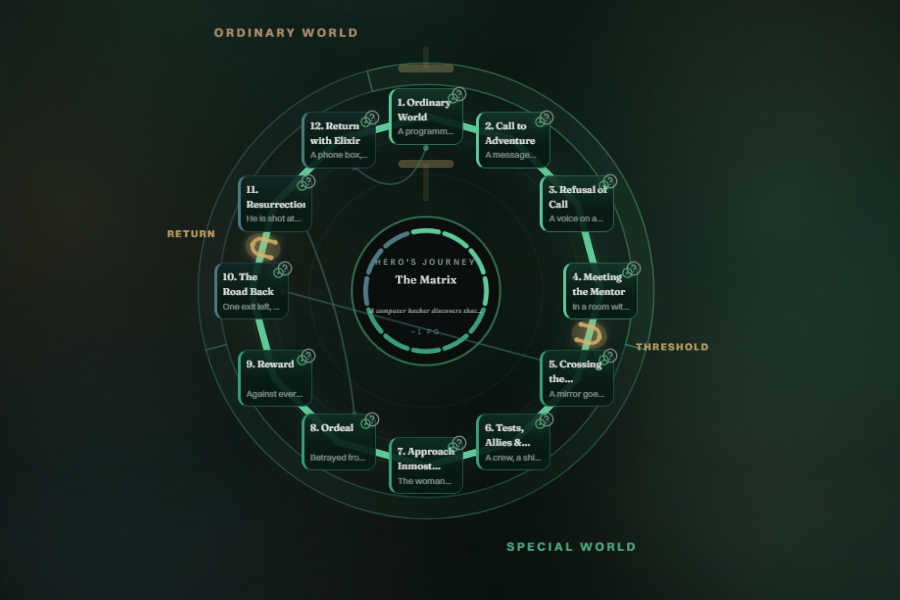
Corrected November 2026: the Matrix and Star Wars lines in this guide were checked against sources (a screenplay or transcript and a scene-by-scene synopsis), and the ones that were wrong in their specifics are rewritten. The Fury Road lines were checked the same way afterwards. The timestamps are gone, because no source gave them.
In Mad Max: Fury Road, the man whose name is on the poster takes the war rig at gunpoint and tries to drive away from the entire story. He gets nowhere, because the rig has kill switches and only the driver knows the sequence. That is a Refusal of the Call, and it does not belong to the hero. It belongs to the passenger.
The Hero’s Journey is the most famous structure in the world and the most misused, because most people learned it as a list of twelve things that happen. Joseph Campbell described it in The Hero with a Thousand Faces as the pattern under the world’s myths. Christopher Vogler compressed it into twelve stages a screenwriter could use. The stages are not events. Each one is a cost the hero has to pay, and the films that use the structure well are the ones that make the payment visible.
This guide walks the twelve stages through three films. Star Wars lays them out with nothing hidden, one sequence and one location each. The Matrix swaps the two worlds, so the ordinary one is the lie. Fury Road splits the journey across two people so it can run at chase speed. By the end you should be able to tell which stage your draft is skipping, and what it should have cost.
The Hero’s Journey in sixty seconds
Campbell’s claim was that the myths of unrelated cultures share one shape. A person leaves the ordinary world, crosses into a special one, is tested, dies in some sense, returns changed, and brings something back that heals the world they left. Vogler, working as a story analyst in Hollywood in the 1980s, turned that into a memo with twelve stages and screenwriting names, later expanded into The Writer’s Journey.
The shape is cyclic. The hero ends where they started, and the story is measured by the difference between the two visits. That is what separates it from three acts, which is a line, and from Save the Cat, which is a line with mirrors. The Journey has one mirror, the Ordinary World and the Return, but everything between them is a descent and a climb, and there are two deaths in it rather than one: the Ordeal in the middle and the Resurrection near the end. The second has to cost more than the first.
It fits stories about transformation, stories with a mentor, and stories where the setting itself is a character. It fits small stakes and static heroes badly, and forcing it onto them produces the checklist films that gave the structure its reputation.
Sylgrove teaches the Journey as twelve stages, after Campbell and Vogler, and you can walk them on a visual map with these three films mapped stage by stage in the Learning library.
The twelve stages, with the films that prove them
The page numbers below are targets in a script of about 120 pages. Watch what each stage takes from the hero. When you can name the cost, you have understood the stage.
Act I
1. Ordinary World
Show the world the hero is about to lose, and what it costs them to stay in it.
In the films
- The Matrix (p. 1): Thomas Anderson, a programmer reprimanded at work for coming in late, is by night the hacker Neo, asleep at his computer at home, who sells a disk for two thousand dollars and asks the buyer if he ever cannot tell waking from dreaming.
- Star Wars (p. 1): a moisture farm, an uncle who holds him back for one more season, and a boy watching two suns set.
- Fury Road (p. 1): a rock fortress whose warlord owns the water, lets it pour down on the crowd below and shuts it off again, and a workforce of dying boys promised an afterlife.
The audience needs a baseline before it can register change, and the Return is measured against this scene, so show what the world gives the hero and what it quietly denies them. The Matrix is the interesting case because its Ordinary World is the illusion, which means every later stage has to work twice: once as an adventure and once as an argument about which reality to believe. Fury Road opens on the villain’s world rather than the hero’s, because the hero’s ordinary world is the road, and the film needs you to know what she is driving away from.
2. Call to Adventure
Put a problem in front of the hero that their ordinary life cannot absorb.
In the films
- The Matrix (p. 10): his screen tells him the Matrix has him and he should follow the white rabbit, a knock brings a buyer with a woman who has a white rabbit on her, and at a party Trinity tells him the answer is looking for him.
- Star Wars (p. 12): a droid plays a fragment of a recorded plea from a woman he has never met, and refuses to play the rest.
- Fury Road (p. 8): on a routine run for fuel and bullets, Furiosa turns the war rig off the road and east into hostile territory, and the reason is hidden aboard the rig.
The call has to be something the ordinary world cannot answer. If the hero could solve it without leaving, there is no threshold and no journey. Two of these calls are fragments, a partial message and a partial recording, and the fragment is the technique: a call the hero can only complete by going. Fury Road makes the call an action already taken. The hero has answered it before the film starts, and the audience is the one being called.
3. Refusal of the Call
Let the hero say no, and show what the fear behind that no is protecting.
In the films
- The Matrix (p. 18): Morpheus, on a phone sent to his desk, steers him to an office window and a scaffold up to the roof. Afraid of the fall, Neo says he cannot do it and is taken into custody.
- Star Wars (p. 20): he tells the old man he has work to do and must get home, offers to take him only as far as Anchorhead, and the story answers by burning the farm.
- Fury Road (p. 45): Max grazes Angharad’s leg with a shot and drives off in the rig alone, until the kill switches Furiosa set stall it and she and the wives catch up on foot.
The refusal is where the audience learns the stakes are real, because someone sensible is afraid of them, and it names the flaw the Ordeal will later break. Star Wars is the model: whatever the hero says he cannot leave is the exact thing the structure removes to make the departure free. A refusal is a price list. Fury Road hands the whole stage to a different character, because the hero has no time to refuse anything, and the passenger refuses on her behalf.
4. Meeting with the Mentor
Give the hero what they need to go, without giving them enough to win.
In the films
- The Matrix (p. 25): two armchairs, two pills, and Morpheus telling him that nobody can be told what the Matrix is. The blue pill ends the story and the red shows how deep the rabbit hole goes.
- Star Wars (p. 25): an old hermit hands over a dead father’s weapon, an incomplete account of how he died, and the name of a discipline nobody believes in.
- Fury Road (p. 70): at a watchtower in the desert, the last of the clan Furiosa was stolen from as a child: armed old women on motorcycles, one of them keeping a bag of seeds from home that will not grow in the sour earth.
The mentor exists to make departure possible, not victory certain, and whatever they hand over should prove insufficient at the Ordeal, or the hero never has to change. Notice that Fury Road puts the mentor late, after the threshold and the tests rather than before them, and immediately before the Ordeal, and it works because what the elders provide is not a tool but the truth. Notice too that Star Wars has its mentor lie by omission. A mentor who tells the whole truth removes the third act.
5. Crossing the First Threshold
Commit the hero to the new world in a way they cannot reverse.
In the films
- The Matrix (p. 30): a mirror goes liquid, he wakes in a pod in a tower of pods, is flushed down a pipe, and is hauled out of the water by Morpheus’s ship.
- Star Wars (p. 35): a spaceport cantina, a pilot and his co-pilot hired for seventeen thousand, and a departure from a planet where nothing is left for him.
- Fury Road (p. 15): Joe leads his whole army after her, and Furiosa drives the rig into a sandstorm and loses every pursuer in it but Nux, whose car she runs down.
This is the act one turn, and the test is simple: could the hero still go home and end the story? If yes, it has not turned. The Matrix crosses the threshold by waking up, which is the inversion the whole film is built on. Fury Road crosses it by driving into weather, and stages the crossing before the Refusal, because a chase cannot wait for its hero to hesitate.
Act II
6. Tests, Allies, Enemies
Teach the hero the rules of the new world by making them pay to learn each one.
In the films
- The Matrix (p. 50): fighting styles loaded into his head, a sparring match he loses, a first jump he fails with blood in his mouth, and a woman in a red dress who turns into an Agent with a gun.
- Star Wars (p. 55): a blind training drill with the helmet down, a pilot who scoffs at the whole idea, and a planet removed from the sky.
- Fury Road (p. 35): out of the storm, Max, still chained to the unconscious Nux, finds the rig and the wives, takes their water at gunpoint, and comes out on top of a brawl with Furiosa and the wives.
This is where the special world becomes legible. Every test should teach a rule the climax will depend on, and every ally should be someone the Ordeal can put at risk. The Matrix teaches one rule in a dozen forms, that belief is a capability, and then spends the third act proving it. Count the rules your Tests stage teaches, and check each is used later. A rule taught and never used is a scene that can go.
7. Approach to the Inmost Cave
Have the hero plan for the confrontation, and show what the plan assumes.
In the films
- The Matrix (p. 65): the Oracle lets him say he is not the One and does not argue, tells him Morpheus will give his life for him, and hands him a cookie.
- Star Wars (p. 65): pulled inside the battle station by a beam they cannot fight, and a plan assembled from stolen uniforms and a stormtrooper who is the wrong height.
- Fury Road (p. 60): in a canyon held by a biker gang, Furiosa stops to hand over the fuel she promised for safe passage, on a deal that assumed a few vehicles behind her and breaks when the bikers count three war parties.
The approach builds dread by making the audience rehearse the danger, and it commits the hero to a plan so the Ordeal can take the plan apart rather than merely surprise them. The Matrix does the hardest thing in the trio here: it splits the mentor in two so that the second one can remove the hero’s belief at the exact point the audience most needs him to have it. A mentor whose most important act is to let the hero believe he is not the one is worth stealing.
8. The Ordeal
Take from the hero the thing they were least willing to lose.
In the films
- The Matrix (p. 80): Cypher sells them out. Morpheus breaks through a wall to fight Smith so the others can get away and is taken, and Cypher, back on the ship, unplugs two of the crew in their chairs.
- Star Wars (p. 80): down a chute into a compactor with something alive in the water and the walls closing. The belly of the beast, rendered as plumbing.
- Fury Road (p. 75): the Vuvalini tell Furiosa that the Green Place was the swamp full of crows they drove through in the night, its water poisoned, and she walks off alone, drops to her knees and screams.
The first death and rebirth. The hero has to lose something they were relying on, because the Reward only means anything if it was bought rather than found. Fury Road’s Ordeal is a piece of information, not an event: what is taken is a destination, and the structure has to survive the discovery that the place the whole journey was aimed at is gone. An Ordeal does not need a monster. It needs a loss the hero cannot argue with.
9. Reward
Let the hero take what they came for, before they understand its price.
In the films
- The Matrix (p. 90): rather than let Tank unplug Morpheus, Neo goes back in with Trinity and a rack of guns, takes a helicopter from the roof, and catches Morpheus in midair.
- Star Wars (p. 90): the prisoner is out of her cell, everyone is out of the compactor, and the group runs for the ship while the old man shuts down the tractor beam alone.
- Fury Road (p. 85): nothing is seized. As the women set out across the salt, Max catches them up with a plan to go back through the canyon and take the undefended Citadel and its water, and Furiosa agrees.
The hero seizes the object of the quest, but the story is not over, which tells the audience the real prize is something else. The gap between the two is the arc. Fury Road’s Reward contains no object at all, and it is the clearest one in the library: what she takes is the understanding that the thing she wanted has to be built rather than found, which is the reward and the bill in one.
Act III
10. The Road Back
Force the hero to choose the journey again, now knowing what it costs.
In the films
- The Matrix (p. 100): Smith shoots out the subway phone before Neo can reach it, Neo fights him and leaves him under a train, then runs for a new exit with the Agents on his heels.
- Star Wars (p. 100): the mentor lowers his weapon and lets himself be struck down in full view of the boy, and the ship gets clear of the battle station.
- Fury Road (p. 95): they drive back the way they came, straight at Joe’s army and on to the same canyon, on a plan to decouple the tanker at the pass and shut the pursuit out behind them.
A second commitment, made with full knowledge where the first was made in ignorance, and the consequences of the Reward should be what starts the chase rather than a new threat. Fury Road takes the stage name literally. The road back is the road out, and the film’s last stretch is its first half reversed. Star Wars spends the Road Back on the mentor’s death, so that from then on the mentor reaches the hero only as a voice.
11. Resurrection
Test the hero on the exact flaw they refused to face at the start.
In the films
- The Matrix (p. 108): he is shot at point-blank range and his body stops, and what starts it again is somebody else saying out loud the thing he has spent the film unable to believe.
- Star Wars (p. 115): in the trench, with Vader closing in, he hears the dead mentor’s voice, switches off his targeting computer and fires by the Force, and his torpedoes find the exhaust port.
- Fury Road (p. 110): stabbed and bleeding, Furiosa climbs onto Joe’s own car and hooks his mask into its spinning wheels, and afterwards, dying of the wound, she is kept alive by Max’s blood.
The second death and rebirth, and it has to cost more than the Ordeal did, because this is the stage that proves the change is real. It must be unwinnable by the hero of act one. Star Wars is exact about it: the mechanical problem was solved on a briefing screen, so the climax cannot be about aim. It is about whether he will switch off the instrument and trust the discipline. The Matrix makes the test a moment where the hero has to stop trying and believe, which is why he is brought back by somebody else’s conviction rather than his own.
12. Return with the Elixir
Bring the hero home with something the ordinary world actually needed.
In the films
- The Matrix (p. 115): from a phone booth inside the Matrix, Neo tells the machines he will show people a world without rules or controls, then hangs up and flies into the sky.
- Star Wars (p. 120): a hall full of people who now have somewhere to stand, and a farm boy walking up an aisle to be decorated by the woman whose recording started it.
- Fury Road (p. 115): Max shows the people Joe’s body, the platform lifts Furiosa and the others as water pours down on the crowd, and Max slips away among them.
The journey only matters if the return heals the world it left, so set this stage against the Ordinary World and check that what the hero carries back answers what that world was missing. Fury Road opened on water released as a demonstration of ownership and closes on water released as a gift. The Matrix returns its hero to the world that was a lie, by choice, which is the only Return that inversion allows.
Where writers go wrong with it
- Treating the stages as a checklist. A film that hits all twelve in order with nothing at stake in any of them is the reason people roll their eyes at this structure. Each stage is a cost. If you cannot say what the stage took from the hero, it did not happen.
- A mentor who solves it. Whatever the mentor gives has to run out at the Ordeal. Obi-Wan gives a weapon and an incomplete story, then dies. If your mentor’s gift is sufficient, the hero never has to change.
- A Refusal that is only a delay. The refusal names what the hero is protecting, and the story should take it. If the farm does not burn, the refusal was just a scene where the hero said no for a while.
- A Resurrection that is just a bigger fight. The second death has to test the original flaw, not the hero’s stamina. Luke’s test is a switch, not a dogfight. Neo’s is standing up. Ask what your hero refused to face in act one, and make that the final test.
- Forgetting the Return. Drafts end at the Resurrection because the plot is over. The structure is not. The elixir has to answer what the Ordinary World was missing, or the journey was tourism.
What to steal
- Split the journey across two people. Fury Road gives the driving and deciding to the hero and the Refusal to the passenger. If your hero has no time to hesitate, someone beside them can.
- Take the belief away at the Approach. The Matrix builds a second mentor whose job is to let the hero believe he is not the one, right before the Ordeal. The third act is stronger for having been doubted.
- Make the Refusal a price list. Whatever the hero says they cannot leave, that is what the story takes. It is the cleanest way to make a departure feel earned rather than convenient.
- Give a Reward with no object in it. A bag of seeds and a decision to turn round. When the prize is an understanding rather than a thing, the Road Back becomes a choice instead of a chase.
- Answer the Ordinary World with the Return. Water as ownership, water as gift. Two suns on a horizon, a medal in a hall. Write the first and last stages together and the whole journey has a shape.
Study it inside Sylgrove
Every film above is mapped to the Hero’s Journey inside Sylgrove, stage by stage, with the craft note beside each one. Open the Learning library and walk the structure on the map:
When it clicks, start a project with the Hero’s Journey as its structure. The twelve stages become the skeleton of your outline, and every one carries the same guidance you just read. Keep the structure, swap in your story.
Films discussed
- The Matrix (1999), written and directed by the Wachowskis.
- Star Wars: A New Hope (1977), written and directed by George Lucas.
- Mad Max: Fury Road (2015), written by George Miller, Brendan McCarthy, and Nico Lathouris, directed by George Miller.