Every screenwriter hits the same wall. You can recite the beats of a structure, name every act, quote the theory, and still stare at a blank page unsure where the midpoint of your story belongs.
The gap is not knowledge. It is pattern recognition. You learn structure the way you learned dialogue: by absorbing hundreds of examples until the shape becomes instinct.
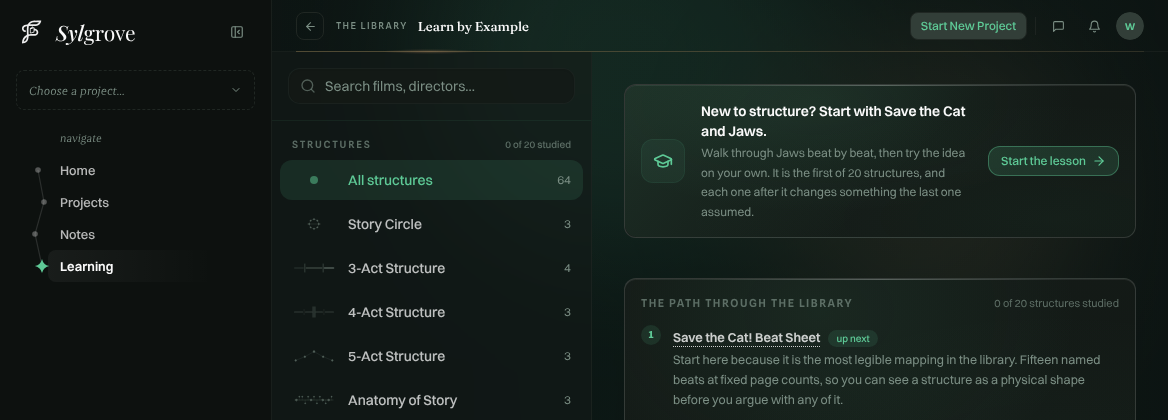
So that is how we built the Learning projects in Sylgrove. Instead of one more explainer on the hero’s journey, we took films you already know and mapped them, beat by beat, onto the structure they use. You open one, walk the structure on a visual map, and at every beat you see two things at once: what happens in the film at that moment, and the craft note explaining why the beat works.
Study the pattern, not the paraphrase
Pick a structure and there is a film that teaches it cleanly. A tightly engineered thriller for Save the Cat. A myth for the hero’s journey. An ensemble for multi-thread. Each one is a worked example: the abstract beat (“break into two”, “all is lost”) anchored to a concrete moment you can picture.
Walking a film this way does something a lecture cannot. You stop memorizing a list and start feeling the rhythm: how long the setup runs before the world tilts, how the midpoint reframes the goal, how the final image answers the first. After a few films, you begin to see your own draft in the same terms.
From example to your own script
When a structure finally clicks, you do not want to admire it. You want to use it. So every Learning project can become a starting point: save an editable copy and the beat sheet turns into the skeleton of your own script. Keep the structure, swap in your story.
That is the whole loop. See how it is done, then do it, with the pattern still fresh.
Going deeper here on the blog
The in-app Learning projects give you the map. This blog is where we go further: full film-by-film breakdowns, the scene detail behind each beat, and notes on the craft decisions that make a structure sing. When a Learning project links out to read the full breakdown, this is where it lands.
Start in the app, open a Learning project, and take a film apart. It is one of the most useful hours a developing writer can spend.