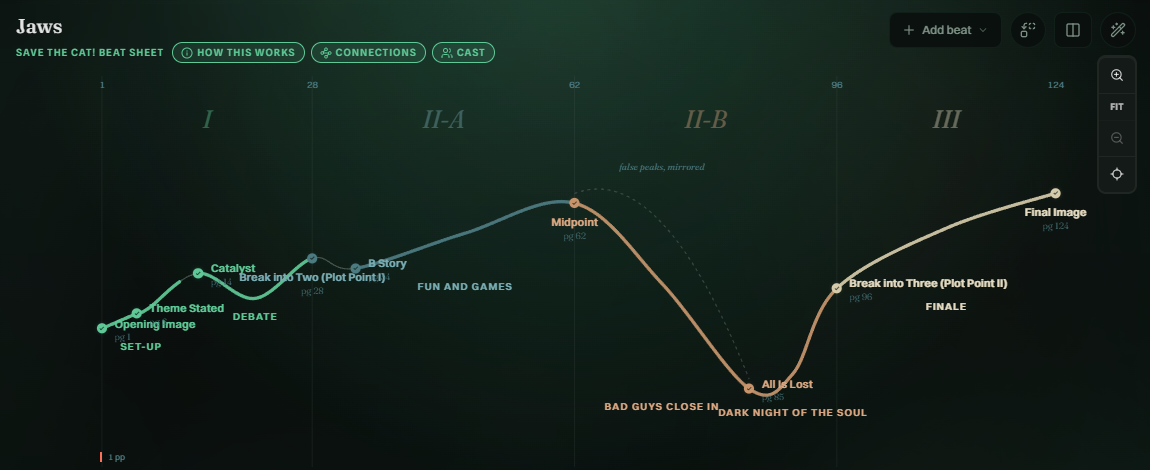
Corrected November 2026: every film moment in this guide was checked against sources (a screenplay or transcript, a scene-by-scene synopsis, and for Jaws, Save the Cat’s own beat sheet of the film). Jaws now follows that beat sheet, which puts the tiger shark at the Break into Two and the attack in the pond at the Midpoint. Several Black Panther and Knives Out lines were wrong in their specifics and are rewritten. The page numbers and timestamps are gone, because no source gave them.
On the Fourth of July in Jaws, the beaches are full, boats are watching the swimmers, and the mayor has talked a family into going in first. The shark comes into the pond instead, where Chief Brody has sent his own son to be safe. It kills a man in a rowboat, and Brody pulls his son out of the water in shock. The town had believed the tiger shark it hung on the dock. The audience never did.
Save the Cat’s own beat sheet of the film calls that the Midpoint, the place where the stakes are raised, and Blake Snyder gave the beat its name. His Save the Cat beat sheet is fifteen beats with a page number attached to each, and it is the most argued-about structure in screenwriting for a simple reason: it works often enough to be suspicious. This guide walks all fifteen through three films that use it three different ways. Jaws runs it the way Save the Cat’s own beat sheet of the film reads it. Black Panther runs it on an argument instead of a villain. Knives Out runs it on the wrong character on purpose.
By the end you should be able to find your own Midpoint, know whether it is a false victory or a false defeat, and see which beats your draft is currently skipping.
Save the Cat in sixty seconds
Blake Snyder was a working screenwriter who noticed that the studio films he sold and the studio films he loved shared a rhythm, and in 2005 he wrote it down as a list. Fifteen beats, each with a target page in a 110-page script. The title comes from his advice that a hero should do something likeable early, like saving a cat, so an audience will follow them somewhere dark later.
The sheet is linear. It is three-act structure with the middle act cut into named pieces, which is exactly why writers reach for it. Three acts tell you nothing about page 60. Snyder tells you page 60 is the Midpoint. Its distinguishing idea is the pair: the Opening Image mirrors the Final Image, Fun and Games mirrors Bad Guys Close In, the false victory at the Midpoint sets up the real defeat at All Is Lost. When the sheet is working, the second half of the script answers the first half beat for beat.
It fits stories with one protagonist who changes, an external problem with a clock on it, and a theme the hero has to learn rather than already know. That covers most studio films and a surprising number of independent ones. It fits ensembles and heroes who do not change much less well, and the end of this guide says what to do about that.
Sylgrove teaches the sheet as fifteen beats, after Snyder, and you can walk them on a visual map with these three films mapped beat by beat in the Learning library.
The fifteen beats, with the films that prove them
Read the three films side by side at each beat. The differences do the teaching. The beats keep Snyder’s order; where a film plays a beat’s scene out of that order, the line says so.
1. Opening Image
Open on a snapshot of the hero’s world that shows what is missing from it.
In the films
- Jaws: under the opening credits, the camera moves through the water from the point of view of something swimming there.
- Black Panther: Wakanda’s origin myth, a meteor and a country that chose to hide.
- Knives Out: the Thrombey mansion at dawn, and Harlan’s body found in the attic study.
The Opening Image is a promise about the Final Image, and Snyder wants you to write the two together. Jaws opens under the water, inside the hunter’s point of view, and closes on the surface in daylight with two men kicking for shore. Black Panther opens on a myth about hiding and closes on a Wakandan ship landing in the open on an Oakland basketball court. Knives Out opens on a house that belongs to a dead man and closes on the same house, seen from its balcony, belonging to someone the family never counted. Choose the opening image for what its opposite will say.
2. Theme Stated
Have a secondary character state the story’s lesson while the hero is not listening.
In the films
- Jaws: as Brody leaves for a missing-person call, Ellen tells him to be careful, and he asks what could happen in a town like this. Denial, stated as a joke.
- Black Panther: young N’Jadaka asks his father N’Jobu whether Wakanda still hides, and when he hears that it does, asks why.
- Knives Out: the relatives keep calling Marta part of the family, and cannot agree whether her family is from Ecuador, Paraguay, Uruguay or Brazil.
The lesson gets said out loud early, by someone with no power to make the hero hear it, and Snyder’s rule is that it should be missable. Jaws hides it in small talk. Black Panther hands it to the antagonist as a boy, a question his father only half answers, so the film’s argument belongs to the villain’s side from the first minutes, which is why the villain is later allowed to be right about the problem. Knives Out does not use a line at all. It uses a running joke, a family insisting on a word it does not mean. Your theme can be a joke. It cannot be a speech.
3. Set-Up
Plant every flaw, want, and relationship the back half will need, in the first ten pages.
In the films
- Jaws: Chrissie leaves a beach party for a night swim and is pulled under. In the morning her remains are found on the sand, and Brody types shark attack into his report.
- Black Panther: a rescue in the forest, a coronation at the falls, and a challenger from the mountains.
- Knives Out: Marta interviewed alongside the family, and the detail that she vomits when she lies.
Everything the back half will spend has to be deposited here. Jaws deposits a procedure: the report typed and the beach-closed signs ordered, in a town that has never owned one, so that the rest of the first half is about whether he will be allowed to act. Marta’s inability to lie without being sick is a comic detail in the first act and the whole mechanism of the Finale. Black Panther uses its Set-Up to stage the ritual combat once, calmly, so the audience knows the rules before the same ritual is used to take the throne. The test for your own Set-Up is short: list what the climax relies on, and check that each item has a scene before the Catalyst.
4. Catalyst
Land the life-changing event that makes the hero’s ordinary world unworkable.
In the films
- Jaws: before Brody can close the beaches, Mayor Vaughn and the town’s leaders stop him on the ferry, and the medical examiner now calls it a boating accident.
- Black Panther: Klaue resurfaces, stealing vibranium from a museum.
- Knives Out: Blanc tells Lieutenant Elliott he was hired by a client he does not know, with an envelope of cash and a clipping about Harlan’s death. Somebody suspects foul play.
The Catalyst is an event, not a decision. The hero is not yet capable of choosing, so the world has to move first. Notice how late Knives Out places it, after the whole family has been interviewed, because the detective in the room only matters once the audience wonders who sent him. Jaws makes its Catalyst a conversation: a mayor on a ferry explaining summer dollars to a chief in his first summer. Save the Cat’s beat sheet calls it the sin that lets the monster into the house. The page target is a guide. The rule is that everything before the Catalyst has to be earning its place.
5. Debate
Let the hero argue against going, so the choice to go is a decision rather than a default.
In the films
- Jaws: Brody watches a crowded beach and jumps at false alarms, until the shark takes Alex Kintner off his yellow raft in front of everyone.
- Black Panther: at the tribal council T’Challa wants Klaue brought home for trial, an elder says Wakanda needs a king rather than a warrior, and W’Kabi asks him to bring Klaue back.
- Knives Out: Marta decides whether to answer the detective’s questions, and the audience does not yet know why the choice frightens her.
The Debate prices the journey. If the hero walks through the door for free, the audience will not believe the door was dangerous. Jaws makes the Debate a vigil: Brody on the sand, watching the water, jumping at every false alarm, and the question of whether the town can get away with it answered in front of everyone at the end of the beat. Black Panther makes it a council scene about a thief, and leaves the bigger question, what Wakanda owes the world, outside the room, where Nakia raised it. Knives Out plays it with the audience one step behind, which is a fair trick as long as the payoff comes, and it comes at the Break into Two.
6. Break into Two
Have the hero actively step into the new world, closing the door on the old one.
In the films
- Jaws: bounty hunters bring in a tiger shark and the town celebrates. Hooper says the bite does not match, Vaughn will not let him cut it open, and Mrs Kintner slaps Brody.
- Black Panther: T’Challa decides to extract Klaue from Busan himself.
- Knives Out: in flashback, Marta believes she has given Harlan a hundred milligrams of morphine with no antidote in her bag, and he talks her through an alibi before he cuts his own throat.
Snyder wants the hero to choose the new world, and two of these films obey. T’Challa chooses Busan. Marta, in flashback, has already made the choice that put her in the new world, and the film’s structure makes the audience live it with her. Jaws breaks the rule. Brody does not choose; the town celebrates the wrong shark, and the boy’s mother slaps him for keeping the beach open. It gets away with that because the slap is what moves him: from here he stops waiting for the mayor, and the choice arrives in full after the Midpoint, when he makes the mayor sign for Quint. If your Break into Two is an event rather than a decision, make sure it is a consequence.
7. B Story
Open the relationship that will carry the theme while the A story carries the plot.
In the films
- Jaws: Hooper brings wine to the Brodys’ dinner, hears from Ellen that Martin hates the water, and says the town caught a shark, not the shark.
- Black Panther: Nakia makes the case for helping people outside the border, the moral counter-voice. The scene plays before the council, not after it.
- Knives Out: the friendship with Harlan in flashback, a nightly game of Go, the only person in the house who actually saw her.
The B Story carries the theme because the A story is too busy. It is usually a relationship, and it usually opens right after the Break into Two, when the hero needs someone to talk to about the new world. Black Panther’s B Story is the film’s conscience, and it holds the argument the council never takes up. Knives Out puts its B Story in the past tense, a friendship with the dead man, and that is why the will reading at the Midpoint lands as grief rather than a windfall. Ask who in your script says what the hero cannot yet say. That is your B Story.
8. Fun and Games
Deliver the promise of the premise, the sequence the poster was selling.
In the films
- Jaws: Brody and Hooper cut open the tiger shark and find nothing human, then find Ben Gardner’s wrecked boat at night, where Hooper pulls a great white’s tooth from the hull and drops it.
- Black Panther: the casino fight and the car chase through Busan.
- Knives Out: made Blanc’s Watson, Marta stays at his side through the search, stepping through her own footprints in the mud while he finds the broken trellis and the mud by the trick window.
This is the poster. Snyder calls it the promise of the premise, and it is the stretch of the script an audience bought a ticket for: the shark movie, the superhero movie, the whodunit. Stakes stay light here on purpose, so the Midpoint has somewhere to go. Writers who front-load jeopardy usually find the second act flat, because they spent the escalation early. Give the premise twenty pages to be enjoyed.
9. Midpoint
Raise stakes to permanent with a false victory or false defeat, and start the clock.
In the films
- Jaws: on the Fourth of July, with boats guarding the beach, the shark comes into the pond instead, kills a man in a rowboat and leaves Brody’s son Michael in shock.
- Black Panther: Klaue is caught and handed to the CIA, then Erik breaks him out. Ross is shot shielding Nakia, and T’Challa sees that Erik wears a ring like his own.
- Knives Out: the will is read, and Harlan left everything to Marta.
The Midpoint is either a false victory or a false defeat, and it raises the stakes permanently. Jaws collects on a false victory: the town believed the tiger shark and opened the beaches, and the attack comes where nobody is watching, to the hero’s own son. Black Panther turns a caught thief into an escaped one, and a stranger into family, with one ring. Knives Out is the most useful of the three, because the genre has already turned at its Break into Two, when the audience stopped asking who did it and started asking whether she would get away with it. Its Midpoint raises that question’s price: the suspect is now the heir. A good Midpoint changes the question the second half is asking.
10. Bad Guys Close In
Tighten the external pressure while the hero’s own flaw dismantles the team.
In the films
- Jaws: Vaughn signs for Quint’s ten thousand dollars, and Brody goes to sea on the Orca with Quint and Hooper sniping at each other.
- Black Panther: Klaue’s body is delivered to the border, and the claim to the throne that comes with it is lawful.
- Knives Out: Ransom gets the truth out of Marta and offers to help her keep the money for a share, while the family presses her to give it back, Walt raising her mother’s immigration status.
Pressure arrives from outside and inside at once. The opposition presses its advantage, and the hero’s own flaw starts costing them allies. Black Panther’s version is the one to study, because the bad guys close in legally. Killmonger’s challenge is legitimate, and T’Challa’s flaw, an inherited certainty that hiding was right, is what leaves him unable to answer it. The beat is not a fight scene. It is the walls moving.
11. All Is Lost
Take the thing the hero most relied on, and let something die with it.
In the films
- Jaws: chumming at the stern, Brody gets his first look at the shark and tells Quint he is going to need a bigger boat. Quint puts it at twenty-five feet and three tons.
- Black Panther: T’Challa loses the ritual combat and goes over the falls, presumed dead.
- Knives Out: at the address in an anonymous email, Marta finds Fran drugged and dying, gives her CPR and calls an ambulance.
Snyder calls this the whiff of death, and he means it literally when he can. Black Panther plays a death everyone believes. Jaws plays a first look: the animal seen whole for the first time, and the boat suddenly too small. Knives Out plays a moral death: the alibi a dead man built for her is spent the moment she calls for help for Fran. The rule is that the thing the hero relied on must go, not merely the hero’s position. If the old plan is still available after this beat, it has not landed.
12. Dark Night of the Soul
Hold the hero at the bottom long enough to see the flaw that put them there.
In the films
- Jaws: Quint’s account of the USS Indianapolis, below deck, with no shark in the scene.
- Black Panther: the ancestral plane, and a son telling his father he was wrong.
- Knives Out: Marta tells Blanc the truth, learns Ransom has already told the police, and insists on confessing to the Thrombeys herself, though it will cost her the inheritance.
This is the beat most drafts rush. The hero has to sit in the defeat long enough to see that the flaw, not the odds, was the problem. Jaws gives it a monologue with no plot in it, and it is the scene people remember thirty years later. Black Panther gives it the film’s thesis, spoken to the dead. Knives Out gives it a decision, and the decision is the arc: a woman who cannot lie choosing to tell the truth when it costs her the house. Let the hero be still here.
13. Break into Three
Let the theme and the B story hand the hero the answer the A story could not.
In the films
- Jaws: the shark attacks the Orca. Fight or die.
- Black Panther: healed, T’Challa is refused an army by M’Baku, and goes back anyway to tell Killmonger he never yielded and is not dead.
- Knives Out: Blanc lays out the whole picture. Ransom arranged everything.
The B Story hands the A story its answer. In Black Panther the B Story is Nakia, and the return is only possible because of the herb she saved. In Knives Out the B Story is the dead man’s friendship, and the truth Blanc assembles is the truth Harlan already knew about his family. Jaws is once more the exception, a Break into Three that is pure event, and once more it works because Brody’s change is about to be spent in action rather than stated. The theme and the plot fuse here. If they do not, the Finale will feel like a different film.
14. Finale
Have the hero act on the lesson and dismantle the opposition for good.
In the films
- Jaws: with Hooper gone under and Quint taken, Brody faces the shark alone and shoots the compressed air tank he has jammed in its mouth.
- Black Panther: while the Jabari join the battle above, T’Challa fights Killmonger down in the vibranium mine, where the trains strip both suits, and stabs him.
- Knives Out: told that Fran has died, Marta says she is alive and ready to talk, holding down her nausea. Ransom gives himself away, she vomits in his face, and the knife he stabs her with is a stage prop.
The hero wins with what they became, not what they had. Brody, who hated the water, ends the film in it. Marta’s flaw, a body that betrays every lie, becomes a weapon she can finally aim: she holds the lie down just long enough. T’Challa wins the second ritual combat because he has changed his mind about what the throne is for, and the film makes him prove it in the beat that follows. If your Finale could have been won by the hero of act one, the arc was decoration.
15. Final Image
Mirror the opening image and let the distance between them be the proof.
In the films
- Jaws: Hooper surfaces alive, and he and Brody kick for shore holding on to the yellow barrels.
- Black Panther: in Oakland, at the building where N’Jobu died, T’Challa tells Shuri it will be Wakanda’s first outreach centre, and a boy asks him who he is. The speech to the United Nations comes during the credits.
- Knives Out: Marta on the balcony with Harlan’s mug, looking down at the family on the lawn.
The opposite of the Opening Image. Write the two together and the distance between them is the arc, which is why this beat is almost never the hard one. If it is hard, the problem is upstream: the Opening Image was not chosen for what its opposite would say.
Where writers go wrong with it
- Treating the page numbers as law. The pages are targets for a 110-page script. Knives Out holds its Catalyst until the whole family has been interviewed, and Black Panther opens its B Story before its Debate. Hit the order and the proportions. Argue with the pages.
- A Midpoint that is just more plot. If page 60 raises the noise but not the stakes, the second half is the first half again. Ask what question the audience is asking on page 59, and make sure it is a different question on page 61.
- Skipping the Debate. Drafts that go from Catalyst straight to Break into Two have heroes who commit for free, and the audience never believes the door was dangerous. Give the hero a reason to say no, and let them say it.
- A B Story that is only a love interest. The B Story exists to carry the theme. Harlan Thrombey is a B Story. Hooper is a B Story. If the relationship never says anything the hero cannot yet say, it is a subplot, not the B Story.
- Forgetting the pairs. Opening and Final Image. Fun and Games and Bad Guys Close In. False victory and real defeat. Half the sheet is the other half reflected, and a beat with no partner is usually the one that feels loose.
What to steal
- Put the theme in the villain’s mouth. Black Panther states its theme as a question the antagonist asks as a boy, so the antagonist gets to be right about the problem. A villain who is right about the problem and wrong about the answer is the most durable kind there is.
- Let a false victory the audience can see through load the Midpoint. Jaws lets the town celebrate a shark the audience already doubts at the Break into Two, then collects at the Midpoint, when the real one reaches the hero’s own son. Dramatic irony does the work of ten pages of tension.
- Plant the Finale’s mechanism as a joke. Marta’s vomiting is comic in the first act and decisive in the last. Anything set up as comedy is set up invisibly.
- Let the Dark Night be a monologue. The Indianapolis speech has no plot in it. It changes what the last act means, which is more than plot could have done.
- Run the sheet on the “wrong” character. Knives Out puts the suspect in the lead and the detective beside her. If a genre’s expected shape is fighting the arc you want to write, move the sheet onto the person who changes.
Study it inside Sylgrove
Every film above is mapped to Save the Cat inside Sylgrove, beat by beat, with the craft note beside each beat. Open the Learning library and walk the structure on the map:
When it clicks, start a project with Save the Cat as its structure. The fifteen beats become the skeleton of your outline, and every one carries the same guidance you just read. Keep the structure, swap in your story.
Films discussed
- Jaws (1975), written by Peter Benchley and Carl Gottlieb, directed by Steven Spielberg.
- Black Panther (2018), written by Ryan Coogler and Joe Robert Cole, directed by Ryan Coogler.
- Knives Out (2019), written and directed by Rian Johnson.