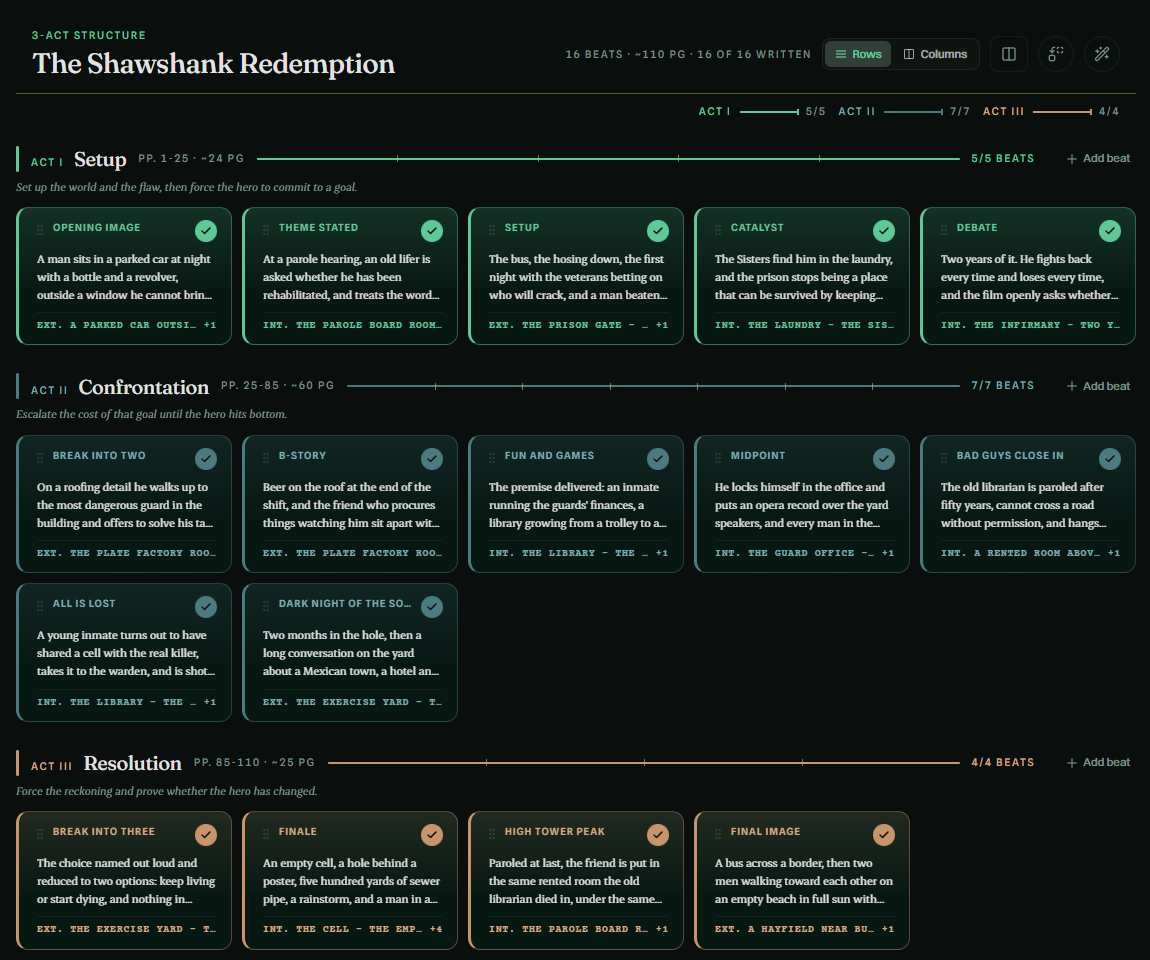
Corrected November 2026: this guide used to teach Sylgrove’s earlier sixteen beats, Blake Snyder’s names plus a “High Tower Peak” no author uses, under Syd Field’s name. The app now teaches Field’s own paradigm, and so does this guide. The map above was captured before the change.
After a month in prison without a word to anyone, Andy Dufresne walks across the yard to Red and asks him to get a rock hammer. That is all. Nobody is hurt, nothing is decided in a courtroom, and the music does not swell. Syd Field, writing about The Shawshank Redemption, puts the end of the first act exactly there, because it is the first time the man the story is about does anything at all.
That is the idea at the center of three-act structure as Field taught it. A story is held in place by two plot points, and a plot point is any incident that hooks into the action and turns it in another direction. This guide walks Field’s paradigm through four films chosen to strain it. Shawshank runs nineteen years through it. Casablanca runs nearly all of its first act through one night in one café. Arrival withholds the meaning of its own opening until the second plot point. Lady Bird runs it with nothing to defeat.
By the end you should be able to find your two plot points, tell your inciting incident from your key incident, and see whether your second act has anything holding it together.
Three-act structure in sixty seconds
Aristotle noticed that stories have a beginning, a middle, and an end. Syd Field, in Screenplay (1979, revised 2005) and The Screenwriter’s Workbook (1984), turned that into a working drawing he called the paradigm. Act I is the Set-Up, about thirty pages of a 120-page script. Act II is the Confrontation, about sixty. Act III is the Resolution, about thirty. One to two to one.
Two plot points anchor the whole thing. Plot Point I ends the first act, somewhere around pages 20 to 30. Plot Point II ends the second, around pages 80 to 90. Inside the first act Field names two incidents: an inciting incident that sets the story in motion, and a key incident that shows what the story is about and draws the main character in. He notes the key incident is often the same scene as Plot Point I. For the long second act, the Workbook adds a midpoint around page 60, which splits it into two halves, and a pinch in each half, a scene that pulls the story back to its central conflict before the half drifts into episodes.
That is nine points, and most of them are positions rather than prescriptions. That is the difference from its neighbors. Save the Cat builds on the same three acts and names fifteen beats with jobs and pages of their own. Field gives you the fixed points and leaves the rest to you. It fits almost any story with a main character and a direction, and it gives you little help with ensembles or with stories that have no single line of action.
Sylgrove teaches the form as Field’s nine points, and you can walk them on a visual map with these four films mapped point by point in the Learning library.
The nine points, with the films that prove them
The page numbers below are the app’s targets for a script of about 110 pages. Field quotes his on 120, so his page 60 is the app’s 55, and the app rescales both to whatever length you set. Four films at every point is a lot, on purpose. Where they agree, that is the form. Where they differ, that is a choice you can make too.
Act I: Set-Up
1. Set-Up (pages 1 to 9)
Use the first ten pages to establish who the main character is, what the story is about, and the situation around the action.
In the films
- The Shawshank Redemption: a young Portland banker sits drunk in a parked car outside the cabin where his wife is with her lover and loads a revolver, cut against his trial for their murders, where he says he threw the gun into a river.
- Casablanca: a narrated refugee route ends in Casablanca, a man with expired papers is shot in a police roundup, and at Rick’s café everyone is buying or selling a way out while Rick, who never drinks with customers, turns a German banker away from his gambling room.
- Arrival: under a narration about memory, fragments of a daughter’s life run from her birth to her death at twelve. Then Louise Banks walks into a lecture hall with almost nobody in it.
- Lady Bird: mother and daughter asleep in a motel bed at the end of a college tour, then both in tears in the car as The Grapes of Wrath ends on tape.
Field gives these pages three jobs: the main character, the dramatic premise, and the dramatic situation. Every opening above does all three before anything is decided. Casablanca states its hero’s position as a rule about drinks, then spends the film arranging requests until the rule breaks. Arrival is the daring one. It hands you the premise and lets you misfile one piece of it, which the second plot point will correct.
2. Inciting Incident (pages 1 to 9)
Land the event that sets the story in motion, usually in the opening pages.
In the films
- The Shawshank Redemption: the night, the lovers, and the trial end in the verdict. The prosecutor counts eight shots from a six-shot revolver and a river dragged for nothing, and the judge gives Andy two life sentences, back to back.
- Casablanca: Ugarte shows Rick two letters of transit taken from murdered German couriers, means to sell them that night, and asks Rick to keep them. Rick hides them in Sam’s piano.
- Arrival: a student asks Louise to put the news on. An object hangs over Montana and more have landed around the world. She sends the class home and calls her mother.
- Lady Bird: she wants an East Coast college, her mother says they can barely afford in-state tuition, and Lady Bird throws herself out of the moving car.
Field says the inciting incident in Shawshank is wrapped in three events, the trial, the car, and the lovers, cut together as one opening sequence. It does not have to be a single scene, and it does not have to involve the main character choosing anything. In Casablanca it is literally handed to him. The test is simple: after this, is the story moving?
3. Key Incident (pages 9 to 28)
Show what the story is about by drawing the main character into the story line.
In the films
- The Shawshank Redemption: Red is turned down for parole after twenty years, then watches a bus bring Andy in and bets on him to break first. That night a guard beats a weeping new prisoner who is dead by morning, and Andy makes no sound.
- Casablanca: the police captain tells Rick that Victor Laszlo must never leave Casablanca, and Rick bets ten thousand francs that he will. Then the police take Ugarte among the tables, Rick refuses to help, and the letters stay hidden in his café.
- Arrival: Colonel Weber plays her a recording of the visitors. She says she has to be in the room with them, and that night a helicopter lands by her house.
- Lady Bird: on the drive to school she asks her father to help with financial aid forms for East Coast schools, on condition that her mother never finds out.
This is the point most writers have never named. Field’s phrase for it is the dramatic premise executed. The inciting incident starts things; the key incident makes this story about this person. In Casablanca it leaves the letters with the one man who says he sticks his neck out for nobody. In Lady Bird it is a secret, and the whole rest of the film is that secret’s life. If your story could still be about anything at the end of Act I, look here.
4. Plot Point I (pages 18 to 28)
End Act I with an incident that hooks into the action and spins it around in another direction.
In the films
- The Shawshank Redemption: after a month of silence, Andy walks up to Red in the yard and asks him for a rock hammer. Red names a price and warns him about the men who have noticed him.
- Casablanca: Ilsa walks in with her husband and asks Sam for the song Rick has banned. Rick comes over to stop it, sees her, and sits down at their table.
- Arrival: through a door that opens every eighteen hours, the team rises into the shell, gravity turns, and two seven-limbed creatures come out of the haze behind glass. Louise panics and the session ends.
- Lady Bird: she kisses a boy after a school dance and comes home to learn her father has lost his job.
Field calls this the true beginning of the story, and the set-up exists to deliver it. Shawshank’s is Field’s own example, and it is worth stealing: the act ends on the main character’s first action, not on something that happens to him. Casablanca’s is the reverse, an event that walks in through the door, and it works because the hero breaks his own rule to meet it.
Act II: Confrontation
5. Pinch I (page 41)
Midway through the first half of Act II, bring the central conflict back into view.
In the films
- The Shawshank Redemption: the warden searches the cells, finds only a rock-polishing kit in Andy’s, trades scripture with him, and hands back his Bible. Soon Andy is in the library doing the guards’ taxes.
- Casablanca: after closing, Rick drinks alone and makes Sam play the song, and the film goes back to Paris: champagne, guns coming closer, a plan to leave together, and a note in the rain.
- Arrival: a month of work buys the simplest reply, while outside the camp a photograph of a visitor spreads and talk radio calls for a show of force.
- Lady Bird: at Thanksgiving, the boyfriend tells her parents that she says she lives on the wrong side of the tracks.
A sixty-page act has room to wander, and the first half usually does. The pinch is Field’s fix: a scene that keeps the story on track by pulling it back to what it is about. None of these is a big event. Each is a reminder, of the institution, the past, the world’s fear, or the money, placed where the middle needs it.
6. Midpoint (page 55)
Around page 60, place the event that links the first half of Act II to the second.
In the films
- The Shawshank Redemption: Andy locks himself in the office and plays an opera record over the yard speakers, and every man in the prison stops moving. Two weeks in solitary follow, and he calls it the easiest time he ever did.
- Casablanca: Ilsa comes back after closing to explain and Rick, drunk, drives her off. The next day she tells him she was already married to Laszlo in Paris, and Laszlo is sent to Rick for the letters.
- Arrival: asked why they have come, the visitors answer with a word that reads as weapon, and one government after another cuts its links to the rest.
- Lady Bird: at Christmas her father hands over the completed financial aid forms in secret, and she asks for a ride to the post office before it closes.
Field gives the midpoint one job: to split the confrontation into two halves of about thirty pages, so each has a destination. Watch what changes across it. In Casablanca the first half is about the past and the second is about the letters. In Arrival the work stops being a puzzle and becomes a race. A midpoint that changes nothing about where the second half is going is only another scene.
7. Pinch II (page 69)
Midway through the second half of Act II, bring the central conflict back again.
In the films
- The Shawshank Redemption: the warden’s work program takes bribes, and Andy launders the money through an invented man with a birth certificate and a Social Security number.
- Casablanca: German officers sing at the piano, Laszlo has the band play the French anthem, Rick nods it through, and the café is closed for it.
- Arrival: against orders Louise and Ian go back in and get the longest answer yet, while soldiers inside the camp set a bomb.
- Lady Bird: suspended for heckling a speaker, she hears her mother throw the wrong side of the tracks back at her, and demands a figure for the cost of raising her.
The second pinch works best when it answers the first, and all four do. In Shawshank the work the warden found for Andy becomes a crime only Andy can run. In Casablanca the music Rick could stop is played again, this time with the room. In Lady Bird the same phrase comes back months later in her mother’s mouth. Link your pinches and the second half of Act II stops reading as a new story.
8. Plot Point II (pages 73 to 83)
End Act II with an incident that spins the action around into Act III.
In the films
- The Shawshank Redemption: a young prisoner once shared a cell with a man who boasted of the murders. Andy takes it to the warden, is sent to solitary, and the young man is shot dead at night on the warden’s signal.
- Casablanca: Ilsa comes for the letters with a pistol, cannot fire, and tells Rick why she never came to the station. Then Laszlo asks Rick to use the letters to take her away, and is arrested.
- Arrival: alone in a pod, Louise learns that the visitors’ gift is their language and that the girl in her visions is a daughter not yet born.
- Lady Bird: waitlisted at a university in New York, she celebrates in secret with her father and asks him to keep it from her mother.
The second plot point turns the story toward its resolution, and it does not have to be a defeat. Shawshank’s closes the legal route for good. Casablanca’s hands Rick the decision from both sides in one night. Arrival’s is a recognition rather than an event, and it re-scores the whole Set-Up without changing a frame of it. Know this point before you write the second act, because the second act is the road to it.
Act III: Resolution
9. Resolution (pages 83 to 110)
Resolve the story in the last act with a solution the first two acts have earned.
In the films
- The Shawshank Redemption: Andy tells Red about a town in Mexico and a hayfield near Buxton. By morning his cell is empty, there is a tunnel behind the poster, the warden’s money is gone, and Red, paroled after forty years, finds Andy on a beach.
- Casablanca: Rick tells the captain he will leave with Ilsa, then at the airfield in fog puts her on the plane with her husband, shoots the major at the telephone, and walks off with the captain.
- Arrival: seeing a reception eighteen months ahead, Louise calls the Chinese general’s private number and repeats his dying wife’s words. The ships leave, and when Ian asks whether she wants a baby, she says yes.
- Lady Bird: after a summer of her mother’s silence, her mother turns back at the airport too late. In New York, with the letters her father saved, she calls herself Christine and leaves a voicemail about her mother’s first drive in Sacramento.
Field is precise about the word. Resolution does not mean ending; it means solution. Shawshank solves its plot early in the act, with the escape and the warden’s fall, and keeps going until it has solved the story, which belongs to Red. Lady Bird solves its story by distance, with nothing settled face to face. Ask what your set-up promised, and check that the last act answers that rather than simply stopping.
Where writers go wrong with it
- A first plot point that raises the stakes but does not turn. If the action is still heading the same way after page 30, Act II is just more Act I. Find the incident that sends it somewhere new.
- One incident doing two jobs badly. A story that starts and defines itself in the same scene often does neither. Ask what sets it moving, then ask what makes it this story, and give each a scene if they are not the same.
- Sixty pages with nothing to aim at. “Confrontation” is a label, not an instruction. Put a midpoint in the middle and a pinch in each half, and the act has four destinations instead of one.
- Pinches that start new subplots. A pinch is a return, not an addition. If your pinch introduces a problem the ending never resolves, it is pulling the story off track.
- Treating the resolution as an ending. The plot can be over and the story unsolved. Shawshank keeps going past its escape because the story was never only the escape.
What to steal
- End the first act on your hero’s first action. Shawshank is Field’s own example: a month of silence, then a request. The act turns because he moves.
- Give the key incident its own scene. Lady Bird makes it a quiet request in a car, and the whole film becomes the life of that secret.
- Link the pinches. Casablanca uses the same gesture twice, music Rick could stop, and the second time the room sings with him.
- Let the second plot point re-read the first act. Arrival turns on a recognition that changes what the opening meant, and the last act needs nothing else.
- Solve the story, not just the plot. Ask whose story it is. In Shawshank the arc is the narrator’s, so the act carries on until he gets out too.
Study it inside Sylgrove
Every film above is mapped to three-act structure inside Sylgrove, point by point, with the craft note beside each one. Open the Learning library and walk the structure on the map:
When it clicks, start a project with three-act structure as its skeleton. Field’s nine points become your outline, and every one carries the same guidance you just read. Keep the structure, swap in your story.
Films discussed
- The Shawshank Redemption (1994), written and directed by Frank Darabont, from the Stephen King novella.
- Casablanca (1942), written by Julius J. Epstein, Philip G. Epstein, and Howard Koch, directed by Michael Curtiz.
- Arrival (2016), written by Eric Heisserer, directed by Denis Villeneuve, from the Ted Chiang story.
- Lady Bird (2017), written and directed by Greta Gerwig.